Showing posts with label India. Show all posts

6.25.2012

A LITTLE DOG NAMED PLASTIC


I didn’t know her name, and she most likely did not have a name the first time I saw her.  It has taken me a long time to write this one.

My first encounter with this lovely little toy fox terrier was in monsoon, in Ram Jhula market. She was tinier than most of the street dogs, make that all of the street dogs, and she certainly looked like a small fox terrier. And she most definitely had their characteristic of fixing their mind and their gaze at the target! She would stand in the middle of the road, tail tucked, fixing her eyes on her restaurant and whatever food was frying for the day. 


Apparently, they would sometimes toss her a bit of food, most likely to make her leave, but still, she would stand there, fixed to her spot, her eyes on the food, and wait. She also liked their buns.

The other sad thing was that she was obviously young, and nursing a litter of puppies. Of course she was hungry, and would stand, and stare, in the rain, waiting for her scrap of food. The poor thing was skeletal. Sometimes she would get food, and on a day when the shopkeeper had enough of her, she would get the stick. I did not know where her puppies were, or how to get her to show them to me, but of course I would bring her food and feed her … if she was there.


After a while, she disappeared. Maybe she just got the stick too many times, or maybe she found a better, kinder, source of food. For a dog who is so small compared to the other street dogs, to physically compete for food from garbage piles is not easy. To stake out spots where mice and rats are known to run, is also not so easy for a small dog.  So, I stopped seeing her and did not know where to find her.

Months went by, and I forgot about the little dog and in the back of my mind just assumed her fate had been the same of so many of the street dogs; after you don’t see them for a long time, you just assume they are dead.

A surprise came that winter, when not far from the food shops, I saw her! Looking rather well, recovered from having to nurse the puppies, and on her own closer to the ghats and under some benches by a chai stall.   No puppies with her, so what happened to them, who knows? She had made this her spot, and seemed to do well with begging for biscuits from the chai drinkers. Of course, I now included her in my regular feedings, so she would have something other than sugar biscuits. Although, I have to admit, she had a fondness for her sweets and would sometimes turn up her nose at the offering of actual dog biscuits!  She liked milk, so I saw to it that she had plenty of that.

The winter turned cold, and she developed no relationship with a street person with whom she could share a bed and a blanket at night, so I bought her a winter coat. It was quite stylish, and it suited her well. She tolerated the evenings’ dressing and the mornings’ removal of her coat, and made no fuss. Others started to take notice, and a guest house owner and another shop keeper let me store her coat in their shops in the day time, even dressing her on the occasions I could not come at night.


After some time of what seemed to be a good, and permanent routine, I started to notice a change in her behavior. She was more reserved, and spending more time under the benches, and not out and about. A bit too reserved for such a young, healthy, and clever dog.  And then I saw it – she was under attack by one of the large, make that very large, females in the area. We called her Big Mama. She was a big golden beast, who had obviously given birth to many litters, and she knew how to find her food. With people she was lovely, but with competitors for food, (even her own pups I later discovered) she was on the attack. The little terrier had become her new target. Having sniffed out a good source of food, Big Mama now saw this as good potential for more food for herself. She would viciously go after the little dog, even if she would see her from a far distance. She was doing her best to make this hers, and little terrier didn’t stand a chance. Even the chai wallahs were not happy about this, they had come to enjoy the little dogs’ company and her engaging ways, but there was nothing we could do.  Big Mama won, and this was now her chai stall.

The little terrier moved on … to the next chai stall! It was not very far, and she was still easy to spot, and this chai keeper was fond of dogs. She stayed for some time, always under the benches, coming out for her bits of sugary biscuits.

One day he asked me, why does this dog not move? Why is she like Plastic Dog?

Plastic dog?

Yes, we call her Plastic. She never moves.

Hmm. Not a name I was particularly fond of, but it stuck. We called her Plastic. My reply to the question of why she never moved was, because you give her too many sweets and she is in a diabetic coma. I got a blank stare. Not that I thought that was really the case, but I had hoped to discourage them from giving her so many sweets.

But she likes them.

But they are not good for her.

Another blank stare.

Then why does she eat them?

She’s addicted to sugar.

Another blank stare.

Little Plastic lived like this for some time, and then it was time for me to make another trip out of India. I wanted to have her sterilized before leaving, but once again, she was gone. Big Mama had moved in on her new turf and chased her out, again. I searched high and low. Everyone knew her by now, and many had their stories of where she was, but none panned out. I had to leave and hope she would be found upon my return, and not pregnant!   Sterilizations have been difficult here, as there is no veterinarian here who is trained to do it. I must rely on volunteer vets, and the odd trip to a larger city, which is extremely costly, and highly impractical, and often unsafe for the dog, health-wise. But we do as many as we can, as we can. Plans are currently in the works to increase the numbers.

I came back after my two months out, and she was still nowhere to be seen. Finally, a word came that she was seen living in the backside of a prominent ashram in the area. I tried to get in, but it was a restricted area, not open to the public, only for paying guests, and a resident boys school. I’d camp out at the entrance as long as I could, but no sign of her, and eventually I would get shooed away, often with a stick waved in front of me. Subtleties are not very common here.

I just want to find a small dog and help her …

No dog! GET OUT! Raising the large stick over my head.

Ashram hospitality?

I would repeat this routine, daily. Perhaps the little terriers tenacity had rubbed off on me. I just had a feeling she may be there.


Then one day, I saw her! I rushed past the guard, who did not look particularly spry to me, plus he was seated, so I thought I’d have a few feet on him, and gave it a go. Little Plastic saw me. It was a reunion Walt Disney would have loved to have on film; kisses, tail wags, and doggie spins and cart wheels. Even the guard with the stick was moved. He did not wave his large stick at either one of us this time. I asked him how long she had been here, and it turned out it had been for some time. Some of the boys in the school had taken a liking to her, and her presence, although “illegal” was unofficially overlooked.

Only problem, she was pregnant.

I went to the office to try to get permission to enter the sacred, unwelcome, grounds, and it worked. Two Americans (yay!) had started working/volunteering there, and they were living in the ashram and were fond of dogs.  They assured me she was welcome, and safe, and would be cared for.

Even the puppies?

Even the puppies.

Okay … I said hesitantly.

The grounds were perfect. She had her own inside room, and beautiful large, unused manicured lawns. Idyllic, really.  She could not have found a better spot for herself, … were it true that she and her pups were welcome …

Delivery

The blessed day arrived, and Plastic delivered four gorgeous, tiny pups! Two males, and two females. They were a beautiful creamy buff color, with white markings. Perfectly divine. The boys adored them, more foreigners were staying there as paying guests who helped with their care, and these were the most beautiful, healthy, well socialized puppies in Rishikesh. Plastic adored being a mother, and took beautiful care of them, and thoroughly enjoyed their company. The entire grounds were theirs, and Plastic proudly pranced down the lanes with her pups in tow; more like a mother duck with her ducklings following behind; it was adorable, and they were clearly happy and care-free.

Change of Plan

The inevitable. Her room would now no longer be available, due to remodeling, and she and the pups had to be forced to live outside. They were no longer allowed even on the terrace of “their” building. So now the daily shooing with the sticks came out. Puppies who were loved and caressed were now threatened and attacked. They learned to stay off the terrace and out of the building for the most part, and they learned fear.

Change of Heart

And one day one of the puppies developed a fever, and became sick. The Dr. was immediately called, and care began, but soon all the puppies were sick. Parvovirus. They were just too young. Weeks of care went on, and the first male died. Then the second, and the girls hung on. Parvovirus is a nasty disease that attacks the lining of the GI track, with bloody diarrhea, high fever, loss of appetite. A complaint came from an ashram resident that the dogs were dirty. Plastic remained well, and cried when the babies were separated from her so they could receive more intensive care. She even found them when they had been moved to a private guest room, far from their original spot.

A guard came one day with a sack, and orders. A plastic sack, with the demand that the dogs, Mom and her two remaining pups, be placed inside. The then volunteer caretaker of the dogs complied. And the dogs have never been seen since. It is unlikely the puppies would have survived, but Plastic was not sick. I can only imagine her terror as she was shoved into a sack, the sack twisted and tied, struggling for air and crushed on top of her two daughters. Her heart must have raced, pounding, and her limbs, struggling, twisting, for as long as they could. Terror.

The story from the ashram was that they were to have been moved, to another ashram compound some 7 kilometers away. They never made it, and little Plastic has never been seen since.  It’s 7 kilometers of highway, jungle, and Ganga.

She is not alive, I knew this in my heart. I hope she was not tossed in the Ganga. I hope she was not tossed in a garbage heap, unable to escape her plastic bag. I hope she was not tossed on a roadway, out of a vehicle, like a bag of garbage down the side of a mountain. And I hope she was not beaten, in her sack, until she could breath no more.

No living being deserves an ending like this.

I cannot say for a fact that any of these scenarios is the one that happened to Plastic in the end, but I can say, for a fact, that they do happen everyday, somewhere, to blessed little souls who do not deserve any of this.

Kali Yuga, the age of Darkness. Kali Yuga, the age of Injustice.


...


What do we do ...


It's hard to take this all in, and feel helpless. We cannot view it as hopeless. For those of us who react, respond with sadness, shed a tear, our reaction can be seen as a blessing in disguise. We are blessed that we have that side of us that is hurt and outraged at these kinds of outcomes and behaviors. This is our gift, these are our moments of divinity; our understanding of "wholeness" and "connectedness". We can use these feelings as motivators;  to give love, and to take action that moves the force of the heart outward and into expansion of love and kindness towards all life.


I had asked one of the boys in the school who had been caring for her if they had named her. One of them shyly replied, "Champa. It means flower." Champa is a kind of flower in India, a beautiful delicate small flower, and it is a beautiful name for her. It was her name in her time of peace, and love.


In her troubled, short life, she touched, and expanded the hearts of many.


                                               CHAMPA

5.31.2012

MANGE AND TVT !


Having settled Yashoda into Rani Park in Kathmandu, I would visit her every other day or so. She was in good hands now in the care of DREAMS, as were the other cows and calves who had come to settle there. Walking the streets in these cities, overcrowded with people, dogs and cows, one is going to come across problems. And I did not have to go very far to find the next set of “problems…”.


Just outside the newly formed cow sanctuary, were a group of the saddest looking dogs I had ever seen. Hairless, depressed, itchy, run down, and full of TVT’s. What’s a TVT? You may ask. It is a transmittable venereal tumor. In other words, a sexually transmitted disease, that leaves a giant tumor looking growth on the dogs’ organs. The females look as though the uterus has fallen out, and the dogs just look like they have a horribly enlarged, mangled, gnarly penis. It can do all sorts of horrible things inside the body as well as outside, but, the good news is, it is highly treatable.

So, by now, my remaining time was running short in Nepal and I was anxious to return to Mother India …I can only stay away so long. What to do? I had met a lovely woman on previous visits who was doing local work in her village. It was worth a call to get information from her as to which vets might I be close to, and get at least started on this. Well, the rain of miracles continued. Kate came out to meet me at the site, and, shocked as I was to see all these dogs, quietly commented … “Wait a minute, I took a dog from this area some weeks ago with the same problem.”


We now had an actual case of “Before” and “After.”


She turned out to be so lovely Kate did not have the heart to bring her back, and was not aware of the extent of the problem in the area. We did a quick survey, took photos, and quickly got one male I had been searching for into the vet’s office. Kate agreed to keep him for follow up care.


I knew this wasn’t enough, and knew it was not fair to burden one person with such an enormous project, and who would pay for all this…?  So, I contacted some lovely people I had met in Pokhara on a previous visit who had an organization called HART; Himalayan Animal Rescue Trust. They do amazing work in Pokhara and the outlying villages, and I thought it was worth a shot to bring this to their attention.


One email got a quick reply, of sure, we can help with the funding. Kate Clendon, of Kopan Community Animal Care, then agreed to continue the treatments of these dogs.


“My” work had never been so easy!


There were local people who had shown great interest in seeing these dogs improve. They were incredulous when we showed them “before and after” photos, and wanted to see success in the condition of their community dogs. And there was, and so it is!


To see the transformations in these dogs health, lives, and spirit is a joy to behold.   


                                   Next

4.30.2011

Kalu of Tapovan

Kalu


Where's Kalu?
The police officer on duty straightened up, looked left, then right, and with all seriousness replied, Kalu has not reported for duty today!

It was cold, he was not well, and I was concerned.

The story of Kalu .... A black and brown hound cross, he had in his early years been the unnofficial police dog at Tapovan chok. Well liked and cared for, until a combination of a road accident and the main officer taking on his care being relocated, changed his circumstances. Fortune smiled on Kalu at that point in his life, and he was taken in by a local woman living with two foreigners. She passed herself off as a sadhu, and a bit of a witch, and claimed to have great healing powers, which later proved to be rather dubious, but more on that later. Kalu was now somewhat lame, and a few years old, but the sorceress and her foreign supporters took on his care. His new home was only a few hundred meters away fom the police station. In a way, his new life had the best of both worlds. A warm home, with lots of company, good food, and daily outings that allowed him to report, on his own innitiative, for duty. Kalu was a rarity for an Indian dog, in that he preferred the company of men, and there he sat. He took his job seriously, not that his activities were specifically prescribed, but he reported on a daily basis, and gave watch over Badrinath Road. Watching the passersby, the traffic, the activities of his fellow workers the police officers, the drama of Indian village life unfolded before his eyes. Kalu knew everyone, and they knew Kalu.

He was well fed in his new home, but the few roti and biscuits that the officers tossed him meant more to him than the Pedigree Pal offered in his house. Evening time he would be rounded up by the sorceress and brought back inside. Another couple of dogs for company, a few cats, and lots of visits from foreigners with their pats and caresses for Kalu, and he had it pretty good.
Life went on like this for some years... But nothing in the world of illusions lasts forever, and the happy home was about to crumble. One foreigner moved out, and the house of relationships based on convenience and need fell apart. Squabbles, recriminations and hurt feelings, and each went their own way. Left in the wake were Kalu, his dog companion Maisy, and more than a few cats. Promises of 'I'll never leave the dogs behind' by the sadhu/sorceress were not kept. All were left behind after living a life of comfort and trust, to fend on their own.
The cats were the first to deteriorate, and the first to go. They were exquisite. Maisy was next, after lasting the better part of the winter, she succumbed, most likely to having injested poison from the streets.

Kalu made his way back to the Police Station, and he made himself happy there. He was not as appreciated as before, but still he was content and had a strong sense of loyalty and satisfaction. This was after all, in his mind and heart, his rightful place. The food was slim, and the bedding was bare; he made his sleeping quarters across the street, in yet another of the unnoficial dumping grounds of India. In the rubble he slept, unmindful of broken glass, stones, garbage, and whatever jetsom made it to the trash that day. He'd bury himself in the pile of whatever, and sleep late into the morning, until the sun had fully emerged.

Quickly losing weight, and being battered by other male dogs his juniors in years but superiors in strength, Kalu didn't look so good. I started feeding him of course, and bandaging his wounds, but it wasn't enough. A temporary respite in a very nearby ashram didn't last long. I found permission for him to stay there, and he did like this spacious home, but he was soon unwelcome, as his condition and beauty deteriorated with age and battle scars of the street. So, once again, he was back on the street, to where else, the Police station.

A new problem now set in, his back legs started to deteriorate. First a bit of dragging, to not being able to hold himself up, and he declined. A few accupunture treatments from a volunteer veterinarian did not help. But still, he peddled himself forward every morning to the front of the Police station, his home, and his place of reporting. When I arrived that winter morning, and Kalu had not 'reported for duty' I knew I had to make a change, and he would not like it. He was independent, strong willed, and did not want to leave his home. But I had to. I put him in my home, and although he cared for me, it was not his home, his work. He was not happy. For many reasons, I had to find him something else.

At this point in time, earlier said ashram (see earlier post) had accumulated a new group of dogs. Once again, dumped by local well wishers who could not keep them, found them, etc., and hoped for the best by placing them in a setting of spiritual bliss ...

maybe

Now fully paraplegic, Kalu had been joined in my home by another paraplegic dog, Lili. Lili was a gorgeous border collie cross, a victim of a road accident, who now scooted about on her two front legs as she effortlessly lifted her back end and walked on her hands, as it were. A very handy makeshift home had been made in a garden of the ashram, and it now seemed to belong to the dogs, literally. Squatters rights! I had been feeding these dogs and arranging for their medical care one by one, and a devoted animal lover within the ashram shared in their care. Life was bliss ...

So I added the new residents, Kalu and Lili. Lili adapted very quickly to her new home, and is an adorable site in the garden. Kalu, although in a much better and healthier environment, bears a bit of a grudge towards me for displacing him from his beloved police station, and forcing what he believed to be an early retirement. Sorry, Kalu, I could not watch you die on the street, unneccessarily. A part of him adjusted to the life of ease, cleanliness, good meals, fresh air, and a view of the Ganga, but he never fully forgot his work, and his job in Tapovan. Had I opened the garden gate, I know he would have dragged himself with every bit of strength he had left in him, to his beloved police station. In his being, Kalu was always prepared to report for duty.


FINAL NOTE ... Kalu passed away, mid January, 2012. He lived in the ashram with its adventures, ease, discord, and love, for one full year.


3.30.2011

A Day in the Life

A day in the life ... Here are a few quick stories and photos of a typical days outing with animal care and meetings with friends . . .

Danni


Danni was another one of those dogs, who somehow just shows up ..
This picture , as many others, does not really show how bad off she appeared. Skeletal, bad skin, infections, and a head that just seemed too big for her body to hold up. And oh yes, a nursing mother. People who were ususally stoic to these kinds of scenes were shocked at her condition. Many people wanted to help her, but she remained elusive, and only sometimes coming out into public sight.
She was initially a bit shy and wary, but eventually gained trust and regularly came for food and affection. One day she actually took me to her home, to show me her pups, and her human family. Yes, she had a family and they were doing their best, but her condition was not good. Over time, with skin treatments, deworming, very good food, she blossomed. She had a gorgeous character, and a bit of a sense of humor. Danni like to hide from upper vantage points and watch me look for her. When I found her, she would not come, but would jump up and down in the air, wagging her big shaggy head from side to side. It was a comical and endearing sight.
The puppies were gorgeous, black and tan, clearly offspring of the neighboring Doberman Romeo. Very little about them looked like the delightfully shaggy haired Danni, except for one... Black and tan like her father, but with a few ruffs of hair encircling her ankles, wrists, and a little shaggy mustache, and oh yes, she had the Danni dance! I came up one morning with food, and Danni did her bouncing dance, and to our great amusement, shaggy daughter mimiced this performance, with joy and smiles. We all laughed. It was all I could do to resist grabbing her up in my arms and carrying her away. But this is impossible, and in the back of my mind, was making silent plans as to how I could at some future point convince the family to let me have Danni. I was that fond of her.

The puppies were eventually placed, but they kept the male, and with Danni looking her best, I did not have to come every day. So I would come up casually, no worries in my mind regarding these two, no sense of need or urgency. And then it hit me. The fear and sadness in the grandmothers eyes.
Danni?
She just shook her head and looked to the rest of the family members for help.
Bagh, bagh ...
Tiger? I asked incredulously.
Tiger.
They took me to the spot up the hill. It was what else, a garbage dumping ground were many animals would go looking for food. The jeep drivers confirmed the report. My lovely Danni had been dragged off by a tiger.

Life of a street dog in India. Life and death of a street dog in India.


Baba and Bubbly


Baba, Bubbly, and all

There are streets that are lined with beggars, Babas, and dogs. They keep each other company, form social circles, and communities of survival. Many people walk along these rows distributing bits of food, as they so feel moved. When I first arrived, I thought this was a depressing site, and with a bit of aversion, would make my way around this road, bypassing these sights. Until I became accustomed to the reality of these conditions, and made regular walks, with conversations and offerings, and found friendships and joys, notwithstanding the difficulties of these lives. There is often a charm to these outcasts and misfits, with whom I find I am regularly at ease. There are many ways to live a life, and hardships and joys come in many forms. This Baba was one of my favorites. Not only did he care for animals, but he had a strong character and his own charm and humor. He has since moved on, but while he was here, with his dogs, we made friends.
He had many dogs around him, and was quite good at understanding their behaviors, and at offering his care, sharing as much as he could. The offerings of 3RS Parleji biscuits seems to be unending in these rows of being, and the dogs get their shares from the babas. The newest edition, he named Bubbly. I thought it was a bit optomistic, considering her condition in those early days, but ok.
Surprisingly, after medicines and good food, Bubbly thrived. She grew into a beauty, and is still alive and very well as I write. She is extraordinarily intelligent, and she charms the local roadside residents daily.
Hari OM Bubbly and Baba


SPOTTY


Ay, ya, yai. What is this small black and white Border Collie style puppy doing with a leg rubbed raw, red , and the size of a baseball bat?! It was quite an unbelievable site. Daily bandaging, antibiotics, good food, etc. ... she improved. She was wonderful about having her dressing changed. Her bad habit was, however, that she liked to lie under the parked auto rickshaws at the roadside where she had made her home, and I often worried that the accident would repeat itself. She was energetic, lively, curious, and all the things a good puppy should be.

I wish I could say all ends well, but although the leg was nearly fully recovered after some weeks, her ability to cross the roads did not improve. With puppy abandon, she darted out onto the street and was killed, I was told.


She lived on the side of the road, and there are no crossing rules for dogs and beautiful Border Collie style puppies, and others.


Ashram Pups 2011


The neverending ashram pups ... new edition, 2011. One by one, a new wave of pups were tossed into the ashram. Make that, sometimes, two by two, three by three, etc...
Unfortunately, this seasons crop came with its own illnesses. Namely, parvo virus. It spread quickly, of course, and nature took its course. With no rhyme or reason as to who would, should survive, based on strength, general health, age, etc. eight survived. The remaining eight were a happy, and strong lot of varied size, shape and color. From our lovely almost laborador, Julie, to the sweet natured beagle looking cross Tommie, to her no relation brother Bairo, later known as Motu. A big golden bear of a dog, who loved to eat and wag his tail and play all day, and eat and wag his tail and play all day.
They all lived quite contentedly, and the seldom used garden, which was first taken over as a hospital ward while the treatments were going on, automatically became their home. They were in. And although there were a few grumbles about dogs in the garden, no one had quite enough clout or heart to be the one to throw them out. As they grew, the confines of the garden became too small for many of them, and they started their natural explorations. This had its own set of casualties, on the roads, with vehicles that speed by and have no time to stop for dogs. Three were lost this way, and reverentially buried on sacred ground. More came to take their place, and for the most part they happily coexist, with squabbles, and power dynamics, but all in all, a good life, better than most.

2011 The PO Pups


The Post Office Pups


There they were, a new edition to the year of 2011. Six gorgeous golden puppies, each one more healthy looking than the next. Some all gold, and some a chocolate gold with soft black muzzle markings. It was impossible to not pick them up and cuddle these small but hefty beings of innocence and trust. It was their first move. Where they came from I was never told and will never know. They were about six weeks old, and placed in a semi-safe semi-private location, the local Post Office. While this may not sound terribly private, or particularly safe, considering the logistics of the building, it had its advantages. One, it had a couple of enclosures in the outer entrance way, where they could curl up and hide, if need be, and two, it was enclosed, from cold and rain, and three, it was just public enough that they could be seen should some well wisher find them irrisistable and be moved to carry one away, and in the world of wishful thinking, take them and provide a home.
Fourth, it was fairly well known that I would sooner rather than later, take notice of them, and take care of them. Mama was new to the area as far as being an outside\street dog, and was most likely a female family pet, who now that she had become pregnant, was put out on her own to take care of herself and her pups. So far she had done a very good job, the puppies were brilliant in their good health and comfort.
The local postmaster turned out to be a very kindly man, who although would not activey acknowledge them, made no comments of complaints of their presence, and made no efforts to have them removed, So, for now they would be safe. The auto rickshaws park up in front of the Post Office entrance, and the drivers genrally had a good time counting puppies and watching their progress. And yes, it was an auto driver who eventually admitted to placing them there, although admitting no relationship of ownership to the mother dog. Still, it was an effort in a world of limited opportunities to provide care for these beings, even with the not unreasonable hope that someone else (me) would give them care.
So, they came, they played, they ate, and for a time they thrived. Mama could come and go, the local garbage dump was just across the street, and if the food I brought was not to her liking, there was always the opportunity to explore and scavange.
Another unexpected bonus to this location, was the semi-permanent addition of a wandering Baba who made the enclaved entrance to the PO his home as well. He stored his belongings in a corner, unrolled his bed bag in the evening, and slept there until morning, before opening hours. So, a Baba, bed and blankets, and six lovely puppies and one mama to keep each other all warm in the cold nights. Morning feedings were now not just for the pups, but for Baba as well, who let me know just how he liked his morning tea and biscuits. Why not? And oh yes, Baba likes his drink as well, so morning time often included several empty bottles of spirits scattered about, which I trust were for medicinal purposes in the cold of the night. Why not?
The not so good parts. The puppies were all girls, so no one would be taking them, no matter how adorable they were. The road the Post Office is on is busy, full on with trucks, autos and motorbikes. And the garbage dump with its full aroma of inviting delicacies was across this street. No matter how much food they would be given, and it was more than ample, the lure of expanded horizons was only a matter of time as they grew and became more mobile and adventurous.
It did not take long for the first accident. The largest, the heftiest, Bertha. The most beautiful and the most advanced was now lame, and frightened as I approached one afternoon. Instead of running out in front of her smaller sisters to greet me, she was cowering, in a corner shaking and in pain. With medical treatment and some days of rest, she seemed to improve; until one morning I came and she was gone. No one knew anything of her disappearance, and she was not seen again. Then there were five. Shortly after that there were four. This time the shop keepers saw it, instant contact with a passing truck, instant death. Yet they were moved, and touched, and with a trace of a tear in his eye the ususally stoic shopkeeper asked if I could not move them somewhere else. The local children who were part of the family of the shop keepers next door would regularly play with them, and enjoy their company, but they too wanted them moved. People were putting their hopes on their survival, and we all knew it was pretty unlikely.


So, on the lookout for yet another hiding place. It had to have safety, access, and no other dogs who already claimed this as their territory. In the middle of the village stood a seemingly abandoned ashram, up the road a bit. Many people walked pass every day, all day, and dogs did go through, but it did not look like anyone lived there. The layout gave a pleasant surprise, as on the top floor was a huge open courtyard, fully enclosed, and secure. Very secure, once I put them in there. How would I get them out. Well, the obvious. I would have to scale the wall several times a day in and out. SO the puppies were moved. Mama could come in and out by utilizing a ramp I set up for her, and the puppies were enclosed. I would take them out to run in the garden in the morning and afternoon, and put them back in at evening time. It worked well for a while, it was just time consuming. The school children saw all this of course, and one morning there were two new additions, Kali and her daughter Kali, courtesy of the school children. They eventually left on their own, to where I do not know, but they were beautifuland gentle and sweet, and I wished them God's grace.
A change was brewing in the ashram setup ... suddenly I was finding the puppies all put out on the outside, and a security guard sleeping on the ground floor at lunch time. Hm, the word is out, squatters have moved in. They may be the four legged kind, but still, squatters. I kept my cool, and just waited him out each day, and when he left, the puppies would go back in, safely tucked away for the night, and in the mornings, I would find them all back out. They were growing, it was ok, they would have to learn their way on the street sooner rather than later anyway. So in a bit more time, the seemingly inevitable, two more disappeared. One was reportedly hit by a motor bike, and the other unknown. The two remaining now were clearly afraid to enter the ashram grounds, so it appeared they were now being forcibley, and aggressively removed. They relocated across the street, and did well for some time; and then there was one. A family has taken her in, but where and for how long, is hard to say.


The life of a street dog.

11.22.2010

BACK IN INDIA ...

Meanwhile, before my time in exile, here are a few of the street dogs in India, and their conditions and stories before I left ...


This is Mama, also called Grandma, as she is the mother and grandmother of many of the dogs of Beach Baba. Surprising all of us, including the local vet, Grandma had another litter of pups. We did not think it was possible, but then, there you are; Incredible India.

The pups were not born at a good time, they were born at the end of the monsoon, and we had seen the greatest rain since nearly 50 years. The beaches, the ghats, the roads were flooded. The pups and Mama had to moved up land several times. When they were returned to Babas cave on the Beach, the sand was dirty, and filled with mud and sand flies. The puppies had to endure very difficult conditions, and skin and parasite problems took their toll.

Still, a few survived, and looked like they would be ok. Baba is ever grateful, and calls these dogs his "children."


Here's a photo taken during a feed and clean. The pups were dewormed, treated for skin eruptions, fed, and happily sent on their way for a day of more play.

All looked good, as good as it can be, and they had a care-taker while I was away.
Soon, the sad news came. Mama/Grandma was gone. She had been ill for one day, with howling and hiding, and the next day she was dead. Three of the pups were also sick, with burns around their muzzles. As I write this, I don't know how many, if any have survived.

Baba was doing his best to care for them, and their loss would be greatly felt by him.

As I write these stories, I realize they are not all full of what we would call happiness. It's not that I go looking for the sad stories or sad endings, it's that this is the reality of the life of a street dog. It is short, it is unpredictable, and it is full of peril.

The few that experience moments of comfort, companionship, and love, are the rarities.

And perhaps we must each do our part to bring a bit of kindness into the world.

11.21.2010

Nepali Detour

kATHMANDU?

Yes, Kathmandu. India visa regulations now want one to leave every six months ... until one gets a new visa, or something like that. Anyway, it's India, and things change.

While in Kathmandu, pining for India, I am getting a better sense of the street dogs here, and the conditions of big city life, vs small city life of a street dog.
Also, I am getting a better sense of big city life of a Nepali, vs small city life , of a Nepali. There are similarities.

This morning while taking an early stroll near Durbar square, I saw the usual cases of mange and neglect. One very sweet gray and black scraggly dog who sat quivering at a busy walking intersection with one paw raised and two runny eyes. He kept looking back and forth, seemingly questioning his surroundings and his sight. I concure.

I had no medicines with me, and had to move on, but will return the next day and hope I see him again. Walking on, half looking at the sweaters being sold on the streets I came upon a sight I couldn't ignore. A small orange colored puppy was silently curled up at a woman's feet, as she sat on her wicker stool overseeing her goods. She was not bothered by the dog, nor was she bothered by the young man who had taken her cigarette lighter, raised the flame, and set it under the dogs ear.

"What!" I stopped him, of course, and all he did was laugh. It was not a nervous laugh, just a laugh, that he had been caught. My yelling caused a stir and created a crowd, but his actions did not. To this there was indifference. Anyway, I tried my best to register some form of remorse from him, but I can't say there was any success in that. Nor any concern from the bystanders; just a few minutes of amusement for them of an irate foreigner, "losing it" over one small orange colored puppy.

What did puppy do through all this ... he slept, and finally awoke when it was all over, completely unaware of the drama going on around him, and over him.
Lucky.

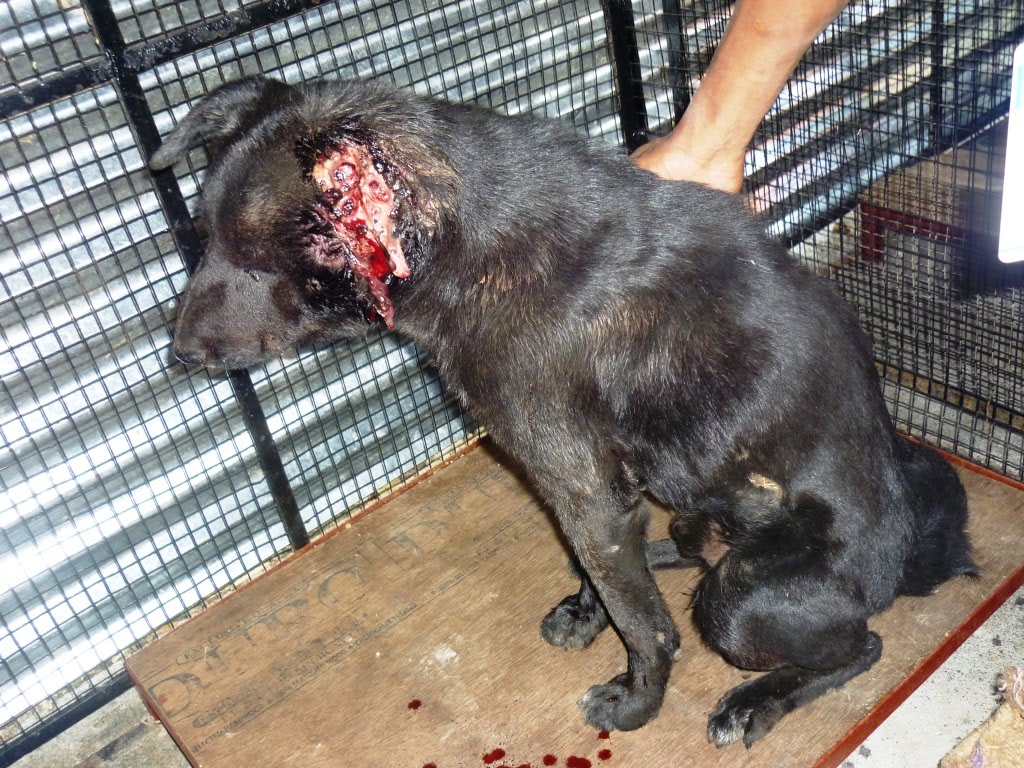
A week or so earlier, I came upon another sad dog with a serious injury, but hopefully a happy ending. I was in Thamel, the tourist trap of Kathmandu. and saw a black dog with a half a head of meat and maggots weaving through the crowds. All the dog wanted to do was take a rest, and try to shake off his pain. He had a horrible wound on his head, it looked as through the skin had been ripped off his left side. The maggots had gotten hold and were feasting on the rotting flesh. I spotted him, lost him, and found him again when I heard a high pitched yelp as he had been kicked by a doorman at one of the hotels. He moved on, and was kicked again by the next shopkeeper. No one wanted him near their premises.

I'm not loud, and I'm not violent by nature, but I was right in the face of the last "kicker" yelling that the dog needs help, not abuse. No reaction. I kept on, and then there was a smirk, another laugh, another kick, and my voice was more raised. This brought out a local man who wanted to know what was going on. Turned out he was also looking for the dog since the day before, and wanted to help him. We joined forces and started to look for the dog, who had moved on from the last kick. Soon, a local vendor was trying to help find him. He knew the dog from the streets, and wanted to help.

We found him, I looped a nylon belt around him, and small miracles came on. Hallelujah. Several people showed up, each wanting to help, some of whom had been looking for him for several days. A fabulous English couple, Andrea and Daz, jumped in. The Nepali man, Jared, arranged for a taxi, and off we went, to KAT Center. Kathmandu Animal Treatment Center.


The taxi driver asked that we open all the windows. He really did smell that bad.


He's being treated, and I visit him and the other dogs there nearly every day.


I'm happy to be of some help while I am here, but desperately miss the ones back in India. The animal care giver staying in my home says the dogs in and around the house are fine, but I'm afraid many of the other reports while I am away are not so kind.

4.14.2010

LONG TIME NO TALK TO …


Although new word entries have not been made, living and staying in India have gone on, and the care of the street animals continues, in its ever evolving, and varied forms.


At times the stories start to sound the same, and one has to make sense of it. Why the repetition, why the commonality, and what’s the point being made? But most of the time, one is so enveloped in the Now, that a re-writing of what has already passed, seems unnecessary. A new story, or a remake of an old story acted out in the present, have taken precedence over reflections of the world of past time and reactivity.

Some stories however, stick out.


Shivani, Bhavani, and Shirdi Sai Baba


June/July sees the oncoming of he Kanwarias; The orange men, as they are commonly called. They come by the thousands, each day. They clog the streets and jam the traffic with their numbers and their rambling. The summer heat is oppressive, and the body heat of an extra 100 to as much as 500,000 a day mixed with the smell of sweat, excrement, and exhaustion can be daunting. They march shoed, barefoot, and in full prostrations. In other towns I was told, they are revered as demi-gods. Men on pilgrimage from the small towns to the holy hills and temples, walking all the way. Never mind the altercations that can leave highways blocked, trains stopped, and busses overturned. Demi-gods of the lesser towns they may be, but not necessarily so in the holy city of Rishikesh, where saints outnumber commoners, but on most days, the merchants rule. Here they are seen for the most part as a nuisance. The flow of spiritual intent mixed with the juices of suppressed testosterone stop the business of the day. Shops are closed, shutters are drawn, sewers are blocked, and sales plummet for a full month and a half. Unless one sells nylon orange shorts and T-shirts, the unofficial uniform of the Kanwarias, sales are absent. Crates of 50 rs orange cloth, the color of the fire of renunciation, made in China, have made their deliveries months in advance, to satisfy the needs of the unofficial dress code of the Kanwarias.


This past year saw something else strange: the beautification of the ghats along the pilgrims path. It was too early for this window dressing to be for the Kumbh Mela that was to come later. This was clearly tied to the timing of the Shaivites march. Ghats which had been unfinished, raw, or neglected were remade, with new marble steps that were polished, decorated, and finely done. There were changing rooms, railings, and even small lawn and garden areas. Completion came just in time for the march, and the shiny new ghats were soon covered with sweat, soil, litter and the overflow of the blocked sewers. The exhausted Kanwarias would take rest here, and the street vendors would set up chai stalls, souvenir shops, flower offerings for the Ganga, and the endless bottles of plastic to be filled with Ganga jal (water). The water is carried along the path to the next holy destination (Neelkanth in this case) and offered to the deities. As with any large gathering, the full effect of the remains of human onslaught is not witnessed until after the crowds have left. But, fresh marble cleans easily, and a bit of water and full sweeping bring the new ghats back to a near pristine state. Beloved Gangaji is asked to absorb the deposits of refuse as the sweepers automatically empty the trash into her flow.


It was in one of these new ghats that I noticed an unintended consequence. The roofed changing rooms that provide shade from the sun and shelter from the rains also became a new location for a housing camp for the Babas. Bedrolls and pots and pans deliberately placed quickly claimed ownership of space, and a small group of the homeless now had a very new and very “upscale” community home. With fresh shelter, human companionship and the prospect of food and relationship, along came the dogs. The young ones, who were too weak and unimpressive to join the established packs that surrounded the new ghat, could start their own community of turf, and relationship.


RADHE, RADHE & SHIVANI


A family of orphaned pups claimed a small corner of the streets not to far away. The most beautiful was a delicate little fur ball of golden brown with a black muzzle, called Radha, the beloved of Krishna. Her beauty was such that many of the locals would pick her up by the scruff, take a quick look to determine her gender, and “Nope,” as a girl, she was immediately dropped back down. Still her beauty was such that I thought she would get enough attention and scraps of food to have as good a chance for survival as one can hope for. She had her human admirers, and they named her Radha. Somewhat overlooked due to the beauty of her sister, was Shivani. A lovely orange colored flat coat cross of a small setter, and humble street dog. Add pale, sea green eyes to a docile gentle manner, and one has a dog of sweet sensitivity, with an ethereal detachment. . But only I seemed to catch that; next to Radha’s good looks, Shivani was somewhat neglected by the local vendors. I named her Shivani, hoping that her illustrious name would open the eyes of the regular vendors, to the special beauty that she was, but it didn’t seem to work. Shivani would continually be called, in a somewhat derogatory tone, “that street dog.”


In just a bit if time, Radha was clearly not doing well, physically. As a somewhat reserved dog temperamentally, she wasn’t the type who would fight for her share of the street scraps that were tossed their way, and she did not thrive. One of the chai vendors asked me why she does not eat fast, ” like the others. This was more than reserve, this was a physical condition, and Radha was declining, fast. I ended up taking her in for treatment, and it took some time, but she became well. Circumstances on the street had changed, and putting her back would bring certain peril and neglect that would again endanger her life. Although it was never my intention to “keep” her, I couldn’t put her back to that location. So for now, she stays with me.


ENTER BHAVANI


I felt guilty about leaving Shivani on the ghats on her own, but she managed to find a new friend, and the two girls bonded and became friends. Enter Bhavani. One day, as is often the case, she just showed up, not fully grown, and not a baby pup, she greeted me as if she had known me all her life. I bent down to give her some food, and she jumped in my half-lap, trying to stay in my lap and not slide down. I could not place her, in my mind or my memory, yet she greeted me as though we were long lost friends. Perhaps I helped her when she was a young pup, and did not recognize her now more grown up. They do remember us, even though help may have been only a simple feeding and a kind word in a random, single encounter. Perhaps another foreigner had helped her, and she now associated foreigners with kindness and help. Or it may be a past life recognition, or a connection of vibration, that she recognized more than I did. Anyway, this little beauty was a fine sheltie cross, with physical and behavioral similarities to a dog I had back in my home country. She was a joy to see and visiting her on what became a daily basis was a pleasure. She was not near by to me, geographically, and she and Shivani required a special trip each day in addition to my regular rounds, of animal care, but they were worth it. Their own ghat, right on the Ganges, with a small lawn area and a new group of Babas; it seemed ideal, and for a few weeks it was. I would come early each morning, as it was too hot after 10:00 to do too much walking. The two dogs, and only a few bathers from the nearby ashram, standing ankle deep in the Ganges, offering their morning prayers would greet my eyes each morning. I was thoroughly pleased, and fully expected to see them thrive.


One morning, however, I came to find Bhavani in obvious pain. This is always a scenario one has to be prepared for. These beings live on the streets, “our” streets; man made and man-ruled. Motorbikes regularly cross these crowded narrow streets at a speed that is convenient for the driver, with no regard for the safety or comfort of who else may share the road. Bike and car accidents are common. This was not an obvious bike accident, however. I tried to give her a simple physical exam as gently as I could, and it soon was obvious it was her back, or spine that was not right. There’s no proper medical facility here for animals. Period. No x-rays, no labs, no hospitals. The Dr. came, prescribed anti-inflammatory medication, the typical injection of B vitamins, and said let’s see.


A small crowd usually gathers when something out of the ordinary occurs, and a dog exam on the street fits that rule. Two young men who knew me by sight, and run a juice stall nearby, immediately offered their explanation … With their fists clenched one atop the other, and swinging their arms up and down, they repeated the word “stick; stick.” I looked at them questioningly, not really wanting to hear the rest, but they nodded their heads, “stick, stickman” and pointed to an unofficial, self-appointed security guard of the ashram. He simply stared, non-pulsed, and walked away. Yes, he had a stick. If someone does not like the presence of a dog, cow, or mule in their vicinity, the “stick” across the back is often the remedy to make their part of the street free from the unwelcome, hapless intruder. Bhavani was tiny, a slim little girl who felt light as a feather when she leapt into your lap. The pain of he stick across such a slender form had to bring shock, and terrible pain.


Confronting this man would have been inappropriate in this situation, and to help the dog, I had to make as little of a scene as possible. My first priority was to see if she could be healed. I would come daily, administer her medication, offer food, and hope a miracle would help her. Walking was difficult for her, and I would carry her from one location to another, in and out of the sun, on and off the grassy areas, and she gently accepted my help. This went on for days, with no signs of improvement. Still she ate, was kept in as minimal pain as possible, and I would continue this for as long as necessary.


Some days later, I saw another one of the “regulars,” a few ghats over, stumbling, back arched, legs splayed, and falling over. It was the same sight I had seen with Bhavani. My breath stopped as my stomach twisted; another one. I heard again from the locals that a man with a “stick”, “stick” had struck again. Then I was told there were others. This dog was very well known to me, and had been named Scruffy. Another scrawny pup I had thought would never make it, but with deworming and good food grew into a lovely and lively dog of the ghats. But now Scruffy’s time had come short. In a few days he was no longer to be seen. I said a prayer, and hoped that his life of pain was now finished.


Bhavani, which means Illuminating, imagining, creator, went on as the same. But she seemed to find a way to accept her physical condition, at least making herself accustomed to it in the way that it no longer predominates ones consciousness with the question of “why” … but accepts, and adjusts. So now when I came, she would eat well, give a bit of a stretch when she finished, and enjoy a light belly rub. And she started to put on a bit of weight, which was good, and she was happy to see me.


I was always as discreet as I could be in my actions with her, but of course, a foreigner on Holy Ground, tending to a dog, is a sight that is noticed. Then it came, the morning of the eruption; “You come here every morning and make a mess!” greeted me as I sat down to feed Bhavani. [No mess was ever made or left]

“You are not wanted here; this is an ashram!”


The words went on and on, in a tone of anger and a color of rage. I quietly replied, “I don’t make a mess” and moved Bhavani up the stairs on to the grassy lawn.


Then I was really in for it. Obviously spurred on by the first Mataji, a second woman starts screaming at me at the top of her lungs, and she is shaking her fist, and her stick at me. Now a crowd had formed, and I am asked to explain myself by a more sober resident of the ashram. He quietly tells me I am doing good, continue, but for now better to move on. Obviously, I move on, after having placed Bhavani in a grassy area, not right on the Ganges. Shaken, I sit to rest not too far away, but well out of sight. I wait a few minutes, and “know” I must go back. The sight is what I had been unconsciously prepared for. Bhavani is dead. She is laying only a few steps from where I had placed her, her body completely stretched out as if she had tried to run. No one from the earlier crowd is to be seen. The area is deserted, eerily quiet, with only her little body on the grass, her life force gone, and no sign of the crowd that had formed there only a few minutes earlier.


I had to turn my shock and grief into something that would turn this around. What could I do that could in any way bring relevance and peace to these kinds of situations? I searched for stories about India’s most holy saints and their views and treatment of the so-called “lesser beings”.


The most beautiful I found was the following; There are many versions of this to be found, but this is a paraphrasing of the first version I found, and the most beautiful.


There is a highly revered saint in India called Shirdi Sai Baba. He lived in the body from a date unknown, to October 15 1918. His Hindus followers call him a Hindu, and there are Muslim followers who also call him a saint. His image is seen throughout India, always with his white beard, headscarf, beatific smile, and left hand up in blessing to those who catch his gaze.


In his ashram, during lunch, a devotee sat down for her lunch in the dining hall. Food was served, and as she was about to eat, a starving, mangy dog walked through the door, and without hesitation she shared her food with him. Sated, he left, and she was about to start her meal again, when a pig wandered in, also looking for food. Again, without hesitation, she shared her lunch with him, and satisfied, he wandered out.


Later that day, in satsang, Shirdi Sai Baba called her by name. …


Thank you for the lovely meal. I am so full. Startled, she looked around, confused. She explained, I have not fed you, I have no means to feed you, I come to the ashram for what I can be given here, myself.


He questioned her:


Did you not feed that hungry dog today? Did you not feed that hungry pig?


Why yes, she replied.


When you fed them, you fed Me. The dog to which you gave the bread, is one with me. So also are other creatures; I am roaming in their forms. So abandon the sense of distinction and duality, and serve the One, as you did today.


I am present in all creation.


This had enormous resonance for me. This is my understanding of worship, and honoring the creations and the creatures in all of their manifested forms of the One. In serving, and giving, and offering what we have to those in need, in offering our heart; we are serving the One, in the best way we know how.


I found many beautiful stories of actions of kindness and care by India’s saints towards our fellow beings, and this is the one that gave me the most comfort. I had the story printed in Hindi and in English, and a few days after beautiful Bhavani’s death, it was distributed amongst the ghats, at the location of her death.


I always ask for a sign when one of my fellow beings that has been in my life has passed on. I usually get one, and it’s very clear. In the stunning circumstances of Bhavani’s death, I had forgotten to ask. I ask it now:


Bhavani, my God, are you all right?


Show me a sign.